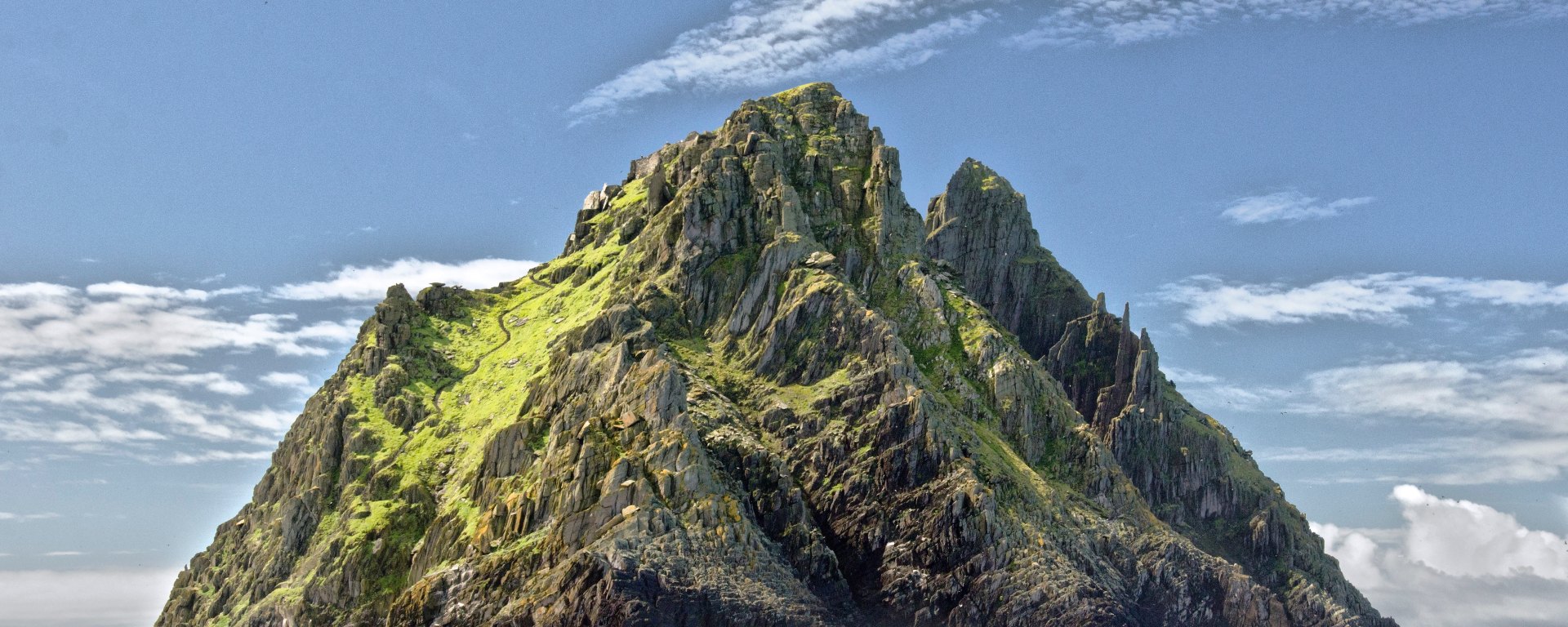
Luke Skywalker from Star Wars might have brought me here, but the overwhelming feeling I have is of entering a scene from an Enid Blyton novel. More specifically, the flashback is of a Famous Five novel in which I could well be making my way to Kirrin Island.
The boat I’m on cuts its way through the choppy Atlantic Ocean, making the 12-kilometre journey from Portmagee to the Skellig Islands in Ireland’s County Kerry in about an hour. My travel companions are an intrepid bunch interested in visiting a striking location from the seventh Star Wars film. Seen in the dramatic last few minutes of Star Wars: The Force Awakens and again in the sequel Star Wars: The Last Jedi is a remote, mysterious island on a planet far away. It’s where Jedi Luke Skywalker is revealed to have been hiding for 30 years. This lonely, mystical place is Skellig Michael, an island somewhat shaped like the Millennium Falcon spaceship, whose geography evokes awe and fascination.
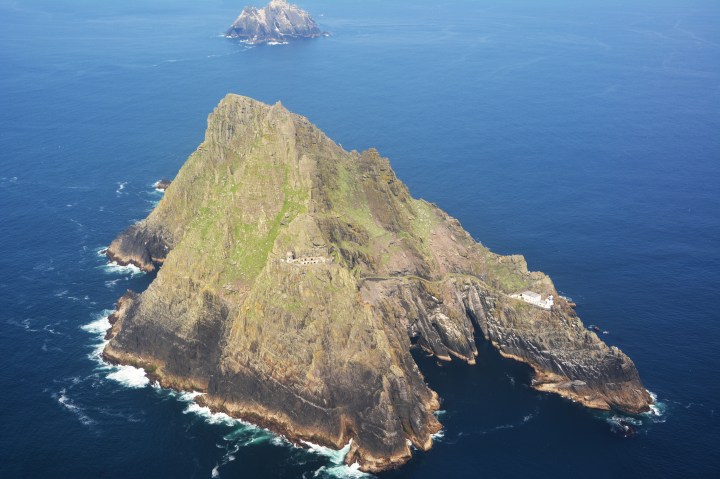
Skellig Michael or Great Skellig, the larger of the two Skellig Islands, is a steep pinnacle rising out of the wild waters of the Atlantic Ocean. It’s here that one of Ireland’s oldest monastic settlements was founded, though much of its early history is unknown. At the northeastern summit of this rocky outcrop are a number of dome-like cells of a monastery where, according to legend, Saint Fionan settled with a group of Christian monks in the sixth century. It remained a monastery until the 16th century, and later became a place of pilgrimage.
The most convenient access to the Skelligs is from Portmagee, a small, pretty fishing village on the Iveragh Peninsula with a population of under 200. It’s the kind of town where fresh fish comes in each evening and goes straight to the kitchen for the cook to prepare supper. That’s exactly what happened on the one night I spent at The Moorings guest house, right opposite the marina.

Our tour boat leaves Portmagee soon after breakfast the next day and nears Little Skellig Island first and circles it. The tops of its craggy cliffs are white, covered with thousands of birds and their droppings. Over 40,000 gannets and other seabirds live on this island, and I’m sure I can see at least 39,999 of them right away. This area hosts one of the largest gannet colonies in Ireland and they are literally everywhere: lining every ridge, swirling overhead, diving majestically to fish in the water, swooping up and down cliffs, in and out of nests, darting to and from their families. When some fly closer, I notice they have a yellow tint on their heads and black tips at the end of their large wings. Interestingly, these seabirds can live for up to 30 years.
We then circle Skellig Michael, and the guide points out the lighthouse and a treacherous old route that the monks once used when they came down from their mountaintop perch to fish for supper. I’m not quite sure what led me to think of this journey as an Enid Blyton adventure, but as we moor at a small cove, it becomes clear. I’d listened to our guide Tammy talk of how the rough seas and windy weather of this area often mean that tour boats don’t leave for their scheduled tours. The unpredictable weather requires that boatmen be extra careful to ensure they don’t crash into the sharp rocks that fringe the shore. It reminds me of the Famous Five dashing against rocks in their wooden boat as they land on Kirrin Island. The thousands of gannets here awaken memories of the gulls and jackdaws of Blyton’s novels, and the idea of a wind-pummelled island close enough to the shore to get there in an hour, evokes even more parallels.
Skellig Michael has for centuries been a significant spiritual site, accessible only by three sets of steep steps cut into its dangerous cliffs. Only the rock-cut steps on the south side are still usable and open to visitors. In the penultimate scenes of Star Wars: The Force Awakens, the lead protagonist Rey runs up this set of rugged, weather-worn stairs. There are about 600 steps to the top, and we’ve been warned so much about how tough it is that I’m mentally prepared. I plan to do what I usually do when I have a massive task ahead of me; I break it down into smaller more manageable parts. Fifty steps at time, 12 times over.
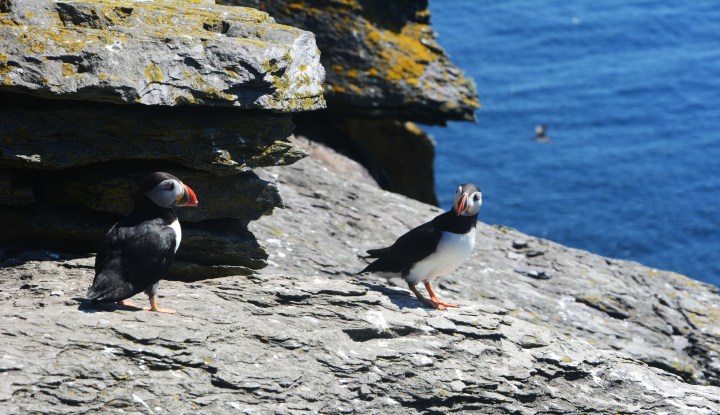
Trudging up the cliff face slowly, I examine the island’s resident birds closely. Until I landed on Skellig Michael, the puffin was a bird I’d only heard about in Enid Blyton’s novels. But now we see them everywhere. This could well be Blyton’s Puffin Island. As we climb the hill they pop out of burrows in the soil, stick their heads out of crevices in the rock, their red beaks, orange feet, and distinctive eye-markings demanding we pay more attention to them. During one of our breaks while hiking I see a puffin near me. It stays put as I edge closer. It seems rather bold considering it doesn’t really see that many humans. After all, only 180 visitors are allowed onto Skellig Micheal every day, to preserve its fragile ecology. When I am about five inches from its beak, Ms. Puffin dives into a hole in the ground.
My companions seem to like the walking pace I set, so I count aloud 1, 2, 3… until we’ve climbed 50 steps. Then we stop for a two-minute breather. We also stop occasionally to look all around us; the views are truly breathtaking. We repeat this a dozen times until we’re at the clifftop.
Before I arrived in Ireland I was told to expect cloudy skies, a fierce Atlantic wind, and always, always rain. But the elements have refused to obey the law of Irish skies and we’ve got blue skies, sunny 18-20°C weather, and not a drop from above. We’ve been gifted the perfect conditions for exploring this UNESCO World Heritage Site.
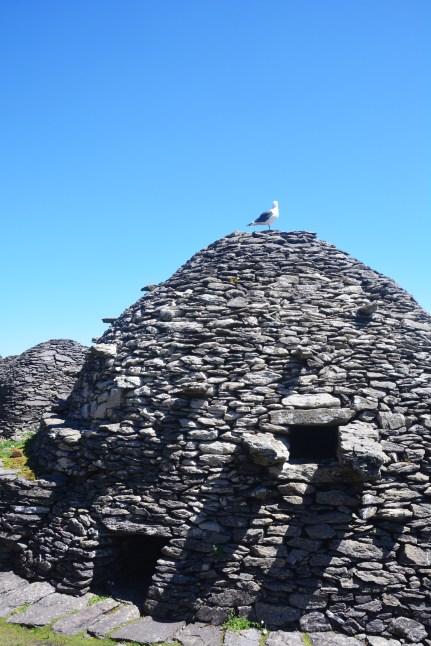
At the top, the beehive-shaped stone huts built and occupied by monks centuries ago are intriguing. The stark monastery complex occupied for some 600 years between the 6th and 12th centuries is where small groups of resident Christian monks lived and prayed. We enter the empty stone structures, wander along low walls, and notice medieval crosses.
On the hike back down from the peak to our boat, we stop on a grassy col with a few flat stones that makes a good picnic spot. Looking out over the island and the ocean from our vantage point, it makes perfect sense why this place was chosen to be the mysterious location for one of the highest grossing films of North America. The rugged landscape of Skellig Michael truly echoes the drama of the movie set on the planet of Ahch-To. The island’s old monastic settlement is also perfectly cast as the galaxy’s first Jedi Temple where Luke Skywalker lives as a hermit. Though it’s just an hour from the Irish coast, it seems like a universe away. It’s the kind of pristine place that’s fast disappearing, its raw beauty accentuated by perilous cliffs and a deep blue sea. We enjoy the warm sunshine and chomp down our ham, cheese, tomato, and lettuce sandwiches. Enid Blyton would approve.
THE INFO
Where? The Skellig Islands lie 12 kilometres off the coast of southwest Ireland and the fishing village of Portmagee.
Getting There From Dublin, Portmagee is about a five-hour drive; it’s about 2hr 45 min from Cork. Plan on hiring a car from either city. From Dublin you can drive to Killarney and then drive the famous Ring of Kerry (route N70). Portmagee in County Kerry is 16 kilometres off this scenic route.
Guided Tours A number of operators offer landing trips from Portmagee, Ballinskelligs, and Valentia Island to the Skelligs from €60/`4,225. Boats operate only when the weather and sea conditions permit and only from about mid-May to end-Sep. Even if a boat does leave the shore, landing on Skellig Michael is not guaranteed. In a sense the stars truly have to be aligned for a trip to work out as planned. Landing on Little Skellig is not permitted.
This piece was written for National Geographic Traveller India and appeared in the April 2017 edition of the magazine.
Top Photo by Michael on Unsplash
All other photos Niloufer Venkatraman
 The Long And The Short Of It